

The past decade has witnessed an unprecedented transformation in the way students access education, as online learning has grown from a flexible alternative to a mainstream method of instruction. The COVID-19 pandemic accelerated this shift, compelling millions of institutions to migrate courses, exams, and assignments into digital spaces. While this transition enabled continuity of education during global lockdowns, it also raised pressing concerns regarding academic integrity. Among these concerns, plagiarism and other forms of academic misconduct became increasingly visible, prompting researchers and educators to examine how the growth of online learning correlates with the frequency of plagiarism incidents. By analyzing empirical data from institutional reports, plagiarism detection platforms, and international surveys, it is possible to understand how the shift to digital learning environments has influenced student behavior and integrity.
The Expansion of Online Learning
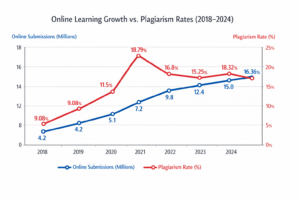
The expansion of online learning during the pandemic was nothing short of dramatic. Prior to 2018, online courses and remote programs were largely supplementary, representing a fraction of higher education activity. However, as the pandemic began in 2020, institutions around the world transitioned to fully remote operations, resulting in an unprecedented increase in digital engagement. Statistical records from plagiarism detection platforms highlight this trend vividly. Submissions for plagiarism checks rose from 4.2 million in 2018 to 7.2 million in 2020, coinciding with the rapid transition to online instruction. By 2024, annual submissions had more than doubled again, reaching 16.7 million. These numbers reflect not only the growing adoption of online learning but also the increasing reliance on digital tools for assignment submission, assessment, and communication between students and educators. The widespread digitalization of coursework created new opportunities for students to engage with external content, whether ethically or otherwise, and this trend has coincided with fluctuations in plagiarism rates over the same period.
Trends in Plagiarism Incidents
Examining the prevalence of plagiarism reveals a pattern that mirrors, though not perfectly, the growth of online learning. In 2018, the global average plagiarism rate was approximately 9.08 percent, a figure that nearly doubled to 18.79 percent in 2020 as remote learning became the default for millions of students worldwide. The sudden surge in plagiarism aligns with the decreased supervision inherent in online environments, where students could access assignments and resources without the traditional classroom oversight that often discourages misconduct. Interestingly, by 2022, the plagiarism rate fell to 15.25 percent, likely reflecting institutional adaptations such as stricter academic integrity policies, increased emphasis on ethical writing, and the deployment of advanced plagiarism detection systems. Nonetheless, by 2023, the rate rose again to 18.32 percent, a surge that coincided with the widespread use of generative AI tools capable of producing text that could be submitted as original work. By 2024, the overall rate declined slightly to 16.36 percent, indicating that while misconduct persisted, increased monitoring and educational interventions were beginning to temper the problem. These fluctuations demonstrate that plagiarism trends are influenced by a combination of external disruptions, technological developments, and institutional responses, rather than by online learning growth alone.
Understanding the Correlation
Empirical studies further support the correlation between remote learning and increased academic misconduct. Research comparing student submissions before and during the early stages of the pandemic indicates that plagiarism rates among online learners increased by approximately ten percentage points, rising from 35 percent to 45 percent in certain datasets. Surveys of educators reveal a similar trend, with about 40 percent of instructors observing higher instances of paper plagiarism after transitioning to remote instruction. Independent reports from the United Kingdom found that nearly 7,000 university students were identified as engaging in cheating with AI tools during a single academic year, a rate of approximately 5.1 cases per 1,000 students, while traditional plagiarism incidents decreased slightly. These statistics indicate that while online learning presents new opportunities for misconduct, the form and methods of cheating have evolved rather than simply increased in volume.
The mechanisms behind this correlation are multifaceted. Remote learning reduces direct supervision and creates a psychological distance between students and instructors, fostering conditions in which some students may feel less accountable. Simultaneously, digital environments facilitate easier access to external sources and information, which students may incorporate into assignments without proper attribution. The emergence of generative AI tools introduces another layer of complexity, as students increasingly use these systems to generate content, sometimes presenting AI-assisted work as entirely their own. The convergence of these factors has created a context in which plagiarism rates respond sensitively to changes in technology, pedagogy, and oversight.
Visualizing the Trend
The diagram below illustrates the correlation between the growth of online learning submissions and plagiarism rates from 2018 to 2024. The blue line represents the total online submissions in millions, while the red line shows the plagiarism rate percentage over the same period. The chart highlights how spikes in submissions and changes in technology coincide with fluctuations in plagiarism incidence.
Interpreting the Data
Interpreting these statistics requires caution, as the apparent correlation does not imply direct causation. Detection tools have become more sophisticated, increasing the visibility of misconduct and potentially inflating the perceived prevalence of plagiarism. Additionally, institutions differ in how they define, monitor, and report plagiarism, leading to variability in the data. Some universities now classify AI-assisted work separately from traditional plagiarism, further complicating cross-institutional comparisons. Despite these challenges, the overall pattern indicates that periods of rapid expansion in online learning coincide with increased exposure to academic misconduct, and the trends are particularly pronounced during disruptive events that challenge established instructional practices.
Institutional Responses to Academic Misconduct
Educational institutions have been adapting their strategies to address these challenges. Assessment methods are increasingly designed to require critical thinking, synthesis, and unique student input, making it more difficult for students to engage in undetected plagiarism. Academic integrity education has become central, with students receiving training in proper citation practices and the ethical use of digital resources. Plagiarism detection tools have also advanced, allowing educators to monitor a broader range of submissions, including those influenced by AI, and to distinguish between acceptable collaboration and misconduct. Institutions that actively analyze trends over time are better able to implement targeted interventions and adjust policies to address emerging challenges, resulting in a more robust framework for maintaining integrity in digital learning environments.
Conclusion
The statistical relationship between online learning and plagiarism reveals both challenges and opportunities for educators, students, and institutions. While the expansion of digital education coincides with periods of increased academic misconduct, particularly during disruptive events or technological shifts, it also provides a platform for innovative approaches to assessment, monitoring, and ethical instruction. Understanding this correlation allows educators to anticipate potential risks, design more effective learning experiences, and implement measures that uphold academic integrity while supporting student learning. With thoughtful planning and evidence-based strategies, it is possible to leverage the advantages of online learning while fostering an environment in which original, high-quality work is recognized, encouraged, and rewarded. As digital education continues to evolve, ongoing statistical analysis and proactive policy implementation will be essential to ensuring that the growth of online learning does not come at the expense of academic honesty.