

Corporate content is omnipresent, ranging from SEO blog posts and social media campaigns to in-depth white papers and investor reports. Businesses recognize content as a strategic asset, yet the risk of plagiarism—whether intentional or inadvertent—can quietly undermine credibility, brand trust, and even legal standing. Unlike academic settings, corporate plagiarism rarely leads to public retractions or disciplinary actions, but the repercussions for brands can be severe. Understanding where plagiarism occurs most often in business content is critical for mitigating these risks.
Defining Plagiarism in Corporate Content
Plagiarism involves presenting words, ideas, or intellectual property that are not one’s own without proper attribution. In the corporate sphere, this can manifest as direct copying of competitor content, paraphrasing without acknowledgment, or the reuse of internal content across different formats without disclosure, sometimes even leading to self-plagiarism. The consequences extend beyond mere ethics. Plagiarism in corporate content can result in SEO penalties, damaged reputation, loss of partnerships, and legal liability related to copyright infringement. The rise of AI-driven content generation tools has further complicated the landscape. While AI can accelerate content production, studies indicate that a significant portion of AI-generated text, particularly from widely used language models, can include unoriginal material unless carefully edited.
Marketing Copy: A Hotspot for Plagiarism
Marketing content, which includes homepage copy, blogs, email campaigns, and advertisements, is among the most common areas where corporate plagiarism appears. The pressure to produce high volumes of content for SEO often motivates teams to borrow structure, phrasing, or ideas from existing high-ranking pages. Outsourced content from freelancers or agencies sometimes arrives with duplicate or near-duplicate text, and marketers may inadvertently paraphrase competitor language without realizing it constitutes plagiarism. Data from recent analyses suggest that nearly sixty percent of AI-generated content exhibits some similarity to existing sources, which underscores how high-volume, performance-driven marketing can inadvertently slip into unoriginal material. Duplicate or plagiarized marketing text not only threatens reputation but can also harm search engine rankings, as almost thirty percent of websites face indexing issues related to duplicate content.
To illustrate these differences visually, the following diagram shows the estimated plagiarism risk across different corporate content types:
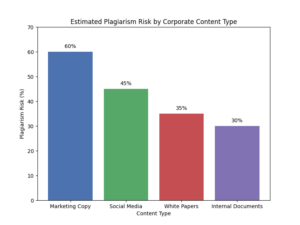
The chart highlights that marketing copy carries the highest risk, followed by social media content, white papers, and internal documents. This visual underscores why companies must pay particular attention to high-volume, outward-facing content.
Social Media and Campaign Messaging Risks
Social media content and campaign messaging, despite appearing informal, also carry plagiarism risks. Platforms like Facebook, Instagram, and LinkedIn encourage viral reuse of memes, slogans, and post formats, making it easy to blur the line between inspiration and copying. Large brands occasionally repurpose trending posts or campaign structures from competitors, risking public backlash if attribution is unclear. While precise statistics on corporate plagiarism in social media are scarce, studies show that content borrowing remains widespread, and even minor rewording of a viral competitor message can be interpreted as plagiarism, potentially damaging brand reputation.
White Papers and Technical Reports: Hidden Vulnerabilities
White papers, case studies, and technical reports might seem immune due to their research-driven nature, yet these in-depth documents are surprisingly vulnerable. These formats often require integrating third-party research, industry statistics, and competitive analysis. Without meticulous citation, paraphrasing industry knowledge or prior reports can inadvertently become plagiarism. Writers under tight deadlines may also reuse internal reports or competitor research without proper attribution. Despite the lack of sector-wide statistics specifically for white papers, the rapid growth of the plagiarism detection market, projected to expand from ninety billion USD in 2023 to over 153 billion USD by 2031, reflects the increasing awareness of content originality risks extending into all business knowledge domains.
Internal Documents and Organizational Risks
Internal corporate documents such as training manuals, policy guides, and newsletters are frequently overlooked as potential plagiarism zones. Employees may reuse external templates or industry reports without acknowledgment, while self-plagiarism—reusing one’s prior work without disclosure—can erode trust within an organization and compromise intellectual property integrity. Internal plagiarism often signals broader organizational challenges, such as insufficient editorial oversight, inadequate guidance on proper attribution, and pressure on teams to produce content quickly.
Statistical Insights and Market Trends
Reliable statistics quantifying plagiarism across corporate content are limited, but several indicators illuminate its scope. Analyses of AI-generated content indicate that nearly sixty percent contains some degree of similarity with existing material, suggesting that high-volume, automated content creation presents significant risks. The plagiarism detection industry’s rapid growth further signals the importance companies place on originality in their digital strategy. Additionally, duplicate content affects nearly thirty percent of websites, demonstrating how issues commonly associated with plagiarism can directly impact search engine performance.
The Consequences of Corporate Plagiarism
The consequences of corporate plagiarism extend beyond immediate reputation concerns. Duplicate content can result in SEO penalties and decreased traffic, while brand perception suffers as customers and partners perceive a lack of originality or trustworthiness. Legal exposure is another risk, particularly when copyrighted material is reproduced without authorization. Public backlash can escalate quickly, especially when plagiarism is detected on widely visible platforms such as social media, underscoring the reputational stakes.
Building a Culture of Originality
Plagiarism in the corporate world is more than copying and pasting; it stems from structural pressures such as high-volume content demands, reliance on external sources, use of AI tools, and weak editorial practices. The formats most vulnerable—marketing copy, social media, white papers, and internal documents—reflect how deeply content creation is embedded in business strategy. Mitigating these risks requires rigorous content review processes, plagiarism detection tools, and a corporate culture emphasizing proper attribution and originality. Maintaining content integrity is both an ethical responsibility and a strategic advantage. In markets saturated with information, a distinct voice and verified authenticity remain among the strongest differentiators a business can claim, reinforcing credibility, brand value, and long-term success.