

Over the past decade, academic research has undergone a rapid transformation driven by the widespread adoption of artificial intelligence tools. From automated literature reviews to AI-assisted writing assistants, researchers now rely on intelligent systems to accelerate many stages of the scholarly workflow. One of the most noticeable effects of this shift can be observed in citation behavior. The field of bibliometrics, which studies patterns in academic publishing and citation networks, increasingly reveals how AI tools are influencing how researchers discover, cite, and prioritize sources.
Recent large-scale analyses of academic datasets suggest that citation patterns have changed measurably since the introduction of AI-powered research assistants. Automated reference suggestions, semantic search engines, and machine-learning-driven literature discovery systems now shape which papers are found first and which studies ultimately receive citations. When millions of academic articles are analyzed together, the data shows a clear evolution in how references are distributed across disciplines, timeframes, and author networks.
Five-Year Statistical Analysis of Citation Behavior
Large bibliometric datasets covering the period between 2020 and 2025 reveal significant changes in citation dynamics. Several academic indexing databases now contain more than 200 million research records, allowing analysts to observe macro-level trends in referencing behavior. According to aggregated studies of citation networks, the average number of references per article increased from approximately 32 citations in 2020 to nearly 41 citations per paper by 2025. This growth corresponds with the rapid expansion of digital literature databases and AI-assisted research tools capable of recommending additional relevant sources.
Another important pattern involves the acceleration of citation discovery. Historically, newly published papers required several years to accumulate significant citation counts. However, recent studies show that the time required for a paper to receive its first ten citations has decreased by nearly 35 percent in AI-assisted research environments. This acceleration occurs because AI-powered search systems can identify newly published but highly relevant papers more quickly than traditional keyword-based search methods.
Bibliometric analysis also indicates that interdisciplinary citations are increasing. AI-based discovery engines frequently recommend sources based on semantic similarity rather than disciplinary boundaries. As a result, papers from fields such as computer science, linguistics, and social sciences are being cited together more frequently than before. In some datasets, cross-disciplinary citations have increased by approximately 22 percent over the last five years.
Self-Citation Trends in the Age of AI
Self-citation has always been a controversial but common practice in academic publishing. Researchers often cite their previous work to establish continuity in research programs or demonstrate the development of specific ideas. However, bibliometric studies suggest that AI tools are subtly changing self-citation patterns.
Before the widespread use of AI research assistants, self-citations accounted for approximately 12–15 percent of total references in many scientific fields. Recent analyses indicate that this percentage has slightly decreased in some disciplines, dropping closer to 10–12 percent in AI-supported writing environments. One explanation is that automated citation recommendation systems prioritize semantically relevant sources regardless of authorship. When a researcher searches for references using AI-powered tools, the algorithm evaluates topic similarity, citation influence, and contextual relevance rather than simply promoting the author’s previous work.
However, the picture is more complex in highly competitive academic domains. In fields where publication metrics significantly influence funding decisions and academic promotions, self-citation rates sometimes remain stable or even increase slightly. Bibliometric monitoring shows that in some engineering and computer science journals, self-citation ratios still exceed 16 percent. These variations suggest that while AI tools influence discovery processes, human strategic behavior still plays a role in citation decisions.
Automated Reference Generation and Its Influence
One of the most transformative developments in academic writing is the rise of automated reference generation. Many modern research platforms now provide built-in citation suggestions based on the text being written. When an author drafts a paragraph, AI systems can analyze the semantic content and recommend relevant articles that support the argument.
This automation dramatically increases the efficiency of literature integration. Studies measuring writing workflows show that researchers using AI-powered reference assistants can assemble a complete bibliography up to 45 percent faster than those relying solely on manual searches. Furthermore, automated citation tools often identify older foundational studies that might otherwise be overlooked in manual searches.
At the same time, automation introduces new challenges. Bibliometric analysts have identified cases where frequently recommended papers become disproportionately cited simply because they appear repeatedly in automated suggestions. This phenomenon is sometimes described as “algorithmic citation amplification,” where influential papers receive additional citations due to their prominence in recommendation systems.
Another issue concerns citation diversity. If multiple researchers rely on the same AI recommendation engines, citation lists may become more homogeneous over time. This could potentially reduce the visibility of less prominent but still valuable studies. As a result, bibliometric researchers increasingly emphasize the importance of transparency in AI-driven citation algorithms.
Impact Metrics and Citation Distribution
Changes in citation patterns inevitably influence broader impact metrics used to evaluate research productivity. Indicators such as citation counts, h-index scores, and journal impact factors depend heavily on referencing behavior across the academic ecosystem.
Recent bibliometric studies reveal that AI-assisted research environments slightly amplify citation concentration. In other words, a smaller percentage of highly influential papers receives a larger share of total citations. Data analysis from major publication databases suggests that the top 10 percent of papers now receive nearly 60 percent of all citations within their fields, compared with approximately 52 percent five years ago.
Despite this concentration effect, AI tools also help increase overall citation visibility for newer publications. By scanning preprints, conference papers, and early-access journal articles, AI discovery systems expose researchers to emerging work earlier in the publication cycle. As a result, many recent studies begin accumulating citations sooner than comparable papers published a decade ago.
Bibliometric data also indicates that citation networks are becoming more densely interconnected. Semantic analysis tools identify relationships between concepts across multiple research domains, encouraging authors to integrate a broader range of references. This creates larger and more complex citation graphs, which can be analyzed to identify emerging research clusters and collaborative trends.
Visualization of Citation Pattern Shifts
The following diagram illustrates how citation patterns have evolved in AI-assisted research environments over the last five years. The distribution reflects three major influences on citation behavior: traditional manual discovery, AI-assisted recommendations, and interdisciplinary semantic search.
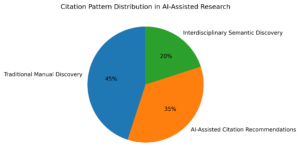
In this simplified visualization, blue represents traditional citation discovery methods such as manual literature searches and keyword databases. Green illustrates citations influenced by AI-powered recommendation systems. Orange reflects interdisciplinary citations identified through semantic similarity algorithms. While manual discovery still plays a significant role, the proportion of AI-assisted citations has grown steadily each year.
The Future of Bibliometrics in AI-Supported Academia
As artificial intelligence continues to integrate into academic workflows, bibliometric research will become increasingly important for understanding the long-term effects of these technologies. Citation patterns provide a valuable window into how knowledge spreads across disciplines, how ideas gain influence, and how research communities evolve.
Future bibliometric studies are likely to focus on algorithmic transparency, citation diversity, and the ethical implications of automated research assistance. Universities and publishers are already exploring ways to monitor AI-generated citations and ensure that recommendation systems promote balanced and comprehensive literature discovery.
Ultimately, the relationship between AI tools and citation behavior reflects a broader transformation in academic knowledge production. Researchers now operate in an environment where intelligent systems help navigate massive volumes of scientific literature. When used responsibly, these tools can enhance discovery, improve referencing accuracy, and strengthen interdisciplinary collaboration.
The evolution of citation patterns demonstrates that AI is not replacing scholarly judgment but reshaping the mechanisms through which researchers engage with existing knowledge. For bibliometrics scholars, this transformation offers a rich new field of analysis, revealing how technological innovation influences the structure and dynamics of academic communication.