

Academic plagiarism has become one of the most widely discussed issues in modern education. With the expansion of digital learning resources, online databases, and artificial intelligence tools, students today have access to more information than any generation before them. While this access has significantly improved learning opportunities, it has also increased the risk of academic misconduct. Surveys conducted in different countries show that plagiarism is far more common than many institutions initially believed. Understanding how often students admit to plagiarism provides valuable insight into the scale of the problem and helps educators develop better strategies to protect academic integrity.Research conducted across universities worldwide consistently reveals that a significant percentage of students acknowledge engaging in some form of plagiarism during their studies. Although exact figures vary depending on methodology and location, the overall trend indicates that plagiarism remains a persistent challenge in both secondary and higher education systems.
Global Survey Data on Student Plagiarism
One of the most frequently cited studies on academic dishonesty comes from the International Center for Academic Integrity. Their surveys have shown that approximately 60–70 percent of university students admit to at least one form of cheating or plagiarism during their academic career. These behaviors range from copying text from online sources without citation to collaborating inappropriately on assignments meant to be completed individually.
Other large-scale surveys provide similar findings. A study conducted among U.S. college students reported that around 36 percent admitted to copying sentences or paragraphs from internet sources without proper attribution. Another 38 percent acknowledged paraphrasing content from online materials without citing the original source.
Survey Results Visualization
To better illustrate how frequently students admit to plagiarism-related behaviors, the following chart summarizes common findings from international academic surveys.
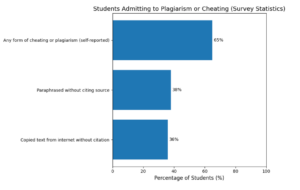
The chart highlights three key patterns found in multiple academic integrity surveys. Approximately 36 percent of students report copying text from internet sources without citation. Around 38 percent admit to paraphrasing online content without referencing the original source. The most striking statistic is that nearly 65 percent of students acknowledge engaging in some form of cheating or plagiarism during their academic career when broader definitions of academic dishonesty are considered.
These findings demonstrate that plagiarism is not limited to isolated incidents but represents a widespread challenge across higher education systems worldwide.
Differences Between Intentional and Unintentional Plagiarism
An important aspect of plagiarism research involves distinguishing between intentional and unintentional misconduct. Many students admit that they do not always fully understand academic citation rules, especially during their first years of study. According to surveys conducted by several universities, up to 30 percent of students reported uncertainty about when citation is required when using online sources.
This lack of understanding contributes to cases of accidental plagiarism. For example, students may paraphrase information but fail to include proper references, believing that rewriting text is sufficient to avoid plagiarism. Although this type of mistake differs from deliberate copying, it still violates academic integrity policies and highlights the need for better education on citation practices.
Intentional plagiarism, however, remains a serious concern. Surveys indicate that between 20 and 30 percent of students admit to deliberately copying text from websites or other academic papers in order to complete assignments more quickly. This behavior is often linked to time pressure, academic stress, or lack of confidence in writing abilities.
The Role of the Internet in Academic Dishonesty
The widespread availability of digital information has fundamentally changed how students approach research and writing. Online articles, open-access journals, and educational platforms provide valuable knowledge resources, but they also make copying content easier than ever before. Surveys show that the majority of students who admit to plagiarism report using internet sources rather than printed materials.
In one large academic integrity study, more than 80 percent of students who admitted to plagiarism said they copied content directly from websites. This statistic illustrates how strongly digital technology influences modern plagiarism trends. The ability to copy and paste text within seconds has lowered the effort required to commit academic misconduct, especially when assignments are submitted electronically.
The Future of Academic Integrity
The rapid development of artificial intelligence tools introduces new challenges for academic integrity. AI-generated writing systems can produce essays and research summaries within seconds, raising concerns about whether students might submit automatically generated content as their own work. Early surveys indicate that a growing number of students experiment with such tools, although reliable global statistics are still emerging.
Educational institutions are responding by updating academic integrity policies and investing in new detection technologies capable of identifying AI-generated content. At the same time, many educators emphasize the importance of teaching critical thinking and original analysis rather than relying solely on automated detection systems.
Conclusion
Survey statistics clearly show that plagiarism remains a widespread issue in global education. Studies consistently indicate that between 40 and 70 percent of students admit to engaging in some form of plagiarism or academic dishonesty during their studies. While many cases result from misunderstanding citation rules, a substantial portion involves intentional copying from online sources.
The rise of digital technology has both increased opportunities for plagiarism and improved the tools available to detect it. Universities now face the challenge of balancing technological solutions with educational approaches that promote ethical scholarship. By strengthening academic integrity education and clearly explaining citation expectations, institutions can significantly reduce plagiarism and support a culture of honesty in academic work.