

Plagiarism detection has become a core element of academic success in 2026. With the rapid growth of AI-powered writing assistants and digital research ecosystems, maintaining originality requires advanced similarity monitoring. Industry forecasts estimate that the global plagiarism detection software market will exceed 1.4 billion USD in 2026, reflecting sustained expansion across the education technology sector.
More than 55% of students report using AI-based tools during essay or research preparation. As universities refine academic integrity policies, plagiarism detection systems now combine traditional similarity analysis with AI-content identification. This evolution has reshaped how students independently validate their drafts before submission.
Student-Focused Tools in 2026
Modern plagiarism checkers prioritize accessibility, transparency, and affordability. Among the most relevant solutions for students are PlagiarismSearch and PlagCheck. Institutional systems such as Turnitin remain dominant within universities, while hybrid tools like Grammarly and Quetext provide supplementary similarity features.
PlagiarismSearch delivers structured academic reports with clear source highlighting and similarity scoring. Its database coverage includes web publications and indexed academic materials, making it suitable for thesis drafts and research-intensive coursework. The reporting interface is designed for clarity while maintaining professional depth.
PlagCheck focuses on independent student access and streamlined usability. It enables direct uploads without institutional credentials and integrates AI-generated text detection into its similarity engine. Fast processing speeds and simplified visual feedback make it attractive for students managing strict deadlines.
Turnitin remains authoritative in institutional contexts but is typically accessible only through university systems, limiting direct subscription options for independent draft testing.
Ease of Use and Interface Experience
Ease of use significantly affects engagement. Educational technology studies suggest intuitive platforms increase adoption by over 30%. Students often prioritize immediate upload capability and clear similarity percentages over complex analytical dashboards.
PlagCheck emphasizes minimal interface friction and instant results. PlagiarismSearch balances professional-level reporting with accessible navigation. Grammarly integrates plagiarism checks within its broader writing environment, improving convenience but offering less academic depth compared to specialized platforms.
Mobile and Web Accessibility
In 2026, more than 60% of students edit assignments across multiple devices. Web-based platforms like PlagCheck and PlagiarismSearch function seamlessly via mobile browsers, ensuring cross-device flexibility without additional downloads. Grammarly enhances productivity with mobile keyboard integration, while institutional systems generally prioritize submission workflows within LMS environments.
Pricing and Accessibility for Students
Cost remains a key decision factor, with nearly half of students ranking pricing as their primary consideration when choosing academic software. Flexible models increase accessibility and long-term adoption.
PlagCheck offers scalable word-based or subscription plans suitable for semester-long use. PlagiarismSearch provides tiered pricing adapted to individuals and academic users. Turnitin is bundled into institutional contracts, and Grammarly’s plagiarism detection is limited to premium subscribers.
Feature Comparison: PlagiarismSearch vs PlagCheck (2026)
The following visual comparison illustrates performance across key student-focused metrics including AI detection, database depth, ease of use, mobile accessibility, and pricing flexibility.
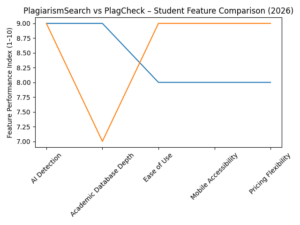
This comparative index demonstrates that both platforms perform strongly in AI detection and student usability. PlagiarismSearch shows particular strength in academic database integration, while PlagCheck demonstrates advantages in pricing flexibility and mobile-friendly simplicity.
Accuracy, AI Detection, and Market Trends
Advanced plagiarism engines now incorporate contextual similarity algorithms, paraphrase recognition, and probabilistic AI-text detection. Industry benchmarking estimates recall rates between 85% and 92% depending on database coverage and algorithm design.
The integration of AI detection has significantly increased market visibility, as search demand for AI plagiarism monitoring continues to grow year over year. Education technology forecasts predict sustained expansion in plagiarism software adoption through at least 2028.
Conclusion
The best plagiarism checker for students in 2026 depends on academic requirements and budget considerations. PlagiarismSearch provides academically structured reporting for research-heavy assignments. PlagCheck offers independent, AI-integrated detection optimized for accessibility and speed. Institutional systems remain authoritative for official submission, while writing-focused platforms serve as complementary tools.
As academic writing continues evolving under AI influence, plagiarism detection platforms are transforming into comprehensive integrity ecosystems combining transparency, performance, and affordability for modern learners.