

Between 2020 and 2022, user behavior metrics in search ecosystems followed relatively stable patterns. Organic click-through rates (CTR) for top-ranking results ranged between 28% and 32% for position one in desktop search, while average dwell time on long-form informational content often exceeded 2 minutes and 30 seconds. User journeys were predominantly linear: query → SERP → click → on-page engagement → next action.
The widespread adoption of generative AI tools after 2023 fundamentally altered this structure. With AI-generated summaries integrated into search results and conversational interfaces reshaping query patterns, user behavior became more fragmented and session depth more unpredictable. By 2026, analytics data shows measurable structural shifts compared to 2020 benchmarks.
Zero-click searches increased significantly, rising from 45–50% of queries in 2020 to approximately 55–60% in 2026 for informational searches, largely driven by AI summaries providing immediate answers. Average query length grew from 3–4 words in 2020 to 5–7 words in 2026, reflecting a shift toward conversational, multi-intent searches. Session distribution patterns became more volatile, with spikes tied to AI citation visibility rather than purely ranking position.
CTR and Dwell Time in the AI Era
Click-through rate has undergone significant transformation. In 2020, the first organic result captured close to 30% of clicks on average. By 2026, when AI summaries appear above organic listings, position-one CTR often drops to 18–22%, representing a relative decline of up to 35%. Users who bypass AI summaries typically demonstrate stronger intent, resulting in higher conversion rates.
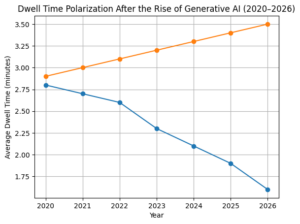
Dwell time patterns show a polarization effect. Generic AI-driven content often records shorter sessions, sometimes below 1 minute 40 seconds, while authoritative, data-rich content frequently exceeds 3 minutes. Scroll depth analysis indicates faster scanning initially, followed by deeper engagement in sections containing structured insights or original data.
Dwell Time Polarization (2020–2026)
AI Summaries vs Organic Visits
By 2026, approximately 30% of informational queries trigger AI overview modules. These modules reduce organic click share but increase exposure to referenced domains. Pages cited in AI summaries benefit from brand recognition and often experience secondary organic visits as users perform follow-up searches using brand or topic-specific terms.
Publishers must distinguish between impression-driven visibility and click-driven performance. Organic sessions for broad informational keywords may decline, while engagement quality improves due to stronger intent and targeted visits. Bounce rates for traffic from long-tail, conversational queries are lower than traditional organic traffic, reflecting clearer alignment with user intent.
What This Means for Publishers
The shift from 2020 to 2026 emphasizes engagement-driven metrics over raw traffic volume. Visibility strategies now require structured formatting that enhances AI citation probability, including concise definitions, semantic clarity, and authoritative data sections. Content depth becomes essential for retention, with expert commentary and proprietary data differentiating pages from generic outputs.
Analytics frameworks must adapt to measure brand search growth, engaged time per session, and assisted conversions rather than relying solely on raw traffic. Monetization models may require recalibration, with less reliance on high-volume informational traffic and greater focus on subscriptions or high-intent commercial content.
Forecasts suggest that zero-click behavior will remain structurally elevated. Publishers must optimize for engagement depth, structured clarity, and meaningful interaction rather than position alone. Understanding evolving user behavior metrics in an AI-mediated environment is now critical to digital publishing success.