

Artificial intelligence has rapidly transformed how written content is produced, refined, and distributed. Among the most influential developments are AI rewriting tools, which can paraphrase, restructure, and refine existing texts in seconds. These technologies promise efficiency and scalability, yet they simultaneously raise serious concerns about content integrity. As rewritten material becomes increasingly difficult to distinguish from original authorship, the concepts of authenticity, ethical use, and intellectual accountability face unprecedented pressure.
The Rise of AI Rewriting in Digital Writing
AI rewriting tools have become deeply embedded in modern content workflows. Industry surveys conducted in 2024 indicate that more than 60 percent of professional content creators have used AI-powered paraphrasing tools, while adoption in marketing and SEO-driven publishing exceeds 70 percent. In academic contexts, approximately 43 percent of students admit to experimenting with AI tools to rewrite essays, research summaries, or coursework. These numbers illustrate that AI rewriting is no longer marginal but central to contemporary writing practices.
The popularity of these tools is driven by practical incentives. They reduce production time, help overcome language barriers, and enable rapid content scaling. However, this convenience introduces a fundamental challenge: when rewriting substitutes for original thinking, the integrity of the content itself becomes compromised.
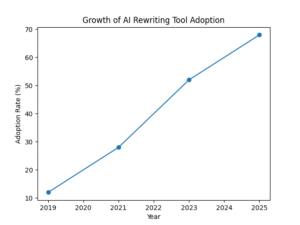
Recent longitudinal data illustrates how rapidly AI rewriting tools have moved from experimental technologies to mainstream writing instruments. Adoption rates grew from approximately 12 percent in 2019 to nearly 68 percent by 2025, reflecting a more than fivefold increase within six years. This acceleration highlights not only technological maturity but also a cultural shift toward automation in writing practices, intensifying concerns about long-term content integrity.
Redefining Content Integrity in an AI Context
Traditionally, content integrity has been anchored in originality, proper attribution, and faithful representation of knowledge. AI rewriting complicates these principles by generating text that appears novel while remaining deeply dependent on source material. Linguistic research shows that AI-paraphrased content often retains between 30 and 50 percent semantic overlap with the original text, even when wording and sentence structure are altered.
This level of similarity creates an ethical gray zone. While the surface text may evade direct duplication, the underlying intellectual structure frequently remains intact. Studies indicate that nearly 40 percent of AI-rewritten academic texts are still flagged by advanced plagiarism detection systems, suggesting that rewriting alone does not guarantee originality.
Academic Integrity Under Increasing Strain
Educational institutions are among the most affected by the rise of AI rewriting tools. Data from European and North American universities reveals a clear shift in misconduct patterns. Traditional copy-paste plagiarism cases are declining, while violations involving AI-assisted paraphrasing are increasing sharply. In the United Kingdom, reports published in 2025 documented several thousand confirmed cases of improper AI use within a single academic year.
Detection remains a major obstacle. Research demonstrates that plagiarism detection accuracy can drop below 60 percent when texts are heavily paraphrased using advanced AI models. This has weakened enforcement mechanisms and forced educators to confront the limitations of existing integrity frameworks. As a result, universities are reassessing how originality should be evaluated in an era where rewriting tools can convincingly mask dependency on external sources.
Professional Publishing and Ethical Risk
The challenges posed by AI rewriting extend far beyond academia. In journalism, corporate communication, and technical publishing, content integrity is directly linked to public trust and legal responsibility. Surveys among media professionals show that nearly half are concerned that AI rewriting tools dilute editorial voice and introduce factual inconsistencies.
Because AI systems rely on probabilistic language generation, rewritten content may inadvertently introduce inaccuracies or reproduce biases present in training data. When such material is published without rigorous human verification, reputational harm becomes a tangible risk. Intellectual property experts also warn that AI-rewritten text may still qualify as derivative work, exposing organizations to copyright disputes even when direct copying is not obvious.
The Limits of Detection Technologies
Detection technologies are evolving, yet they struggle to keep pace with rewriting sophistication. Empirical studies reveal that aggressive paraphrasing can significantly reduce detection reliability, especially when semantic structure is preserved but lexical similarity is minimized. This ongoing technological imbalance suggests that content integrity cannot be safeguarded through automated tools alone.
Organizations relying exclusively on detection software face a false sense of security. Experts increasingly argue that ethical governance, editorial accountability, and transparency are more effective long-term safeguards than technical detection measures in isolation.
Transparency and Responsible AI Use
Public perception data indicates that transparency plays a central role in maintaining trust. Surveys show that over 70 percent of readers support disclosure when AI tools are used in content creation, particularly in educational and journalistic environments. Disclosure does not reduce credibility; instead, it signals ethical awareness and professional responsibility.
Research in professional writing environments demonstrates that AI rewriting, when used as an assistive tool rather than a substitute for authorship, can improve clarity and accessibility without undermining originality. The decisive factor is human oversight. Content reviewed, contextualized, and validated by experts maintains integrity even when AI contributes to its refinement.
The Future of Content Integrity
The future of content integrity will not be defined by prohibiting AI rewriting tools but by redefining standards around their use. Educational institutions are beginning to adopt assessment models that emphasize reasoning, reflection, and personal engagement, which are less susceptible to automated rewriting. Publishers and organizations are developing internal policies that combine ethical guidance, human editorial review, and selective use of detection technologies.
Statistical trends confirm that AI rewriting tools are permanent fixtures of the writing landscape. Preserving integrity in this environment requires adaptive frameworks that balance innovation with accountability. Ultimately, while AI can reshape how content is expressed, the responsibility for truth, originality, and ethical authorship remains fundamentally human.