

Defining Plagiarism and Its Impacts
Plagiarism broadly refers to the unauthorized use of another’s intellectual property, including text, ideas, data, or creative work. Its impact extends beyond mere academic misconduct, affecting the integrity of research and the credibility of institutions. In the digital age, plagiarism has become simultaneously easier to detect and more complex to manage. The widespread availability of online resources, paraphrasing tools, translation services, and generative AI has created both opportunities and challenges for those seeking to uphold originality in academic and professional writing. According to global reports, incidents of plagiarism are closely linked to broader patterns of academic dishonesty, which may erode trust in scholarly output if left unchecked.
Global Trends from 2018 to 2024
Longitudinal analysis allows researchers to move beyond single snapshots of plagiarism and examine how incidents evolve over time. A key dataset covering submissions from 2018 to 2024 provides insights into global trends in plagiarism rates. The average rate of plagiarism increased sharply from 9.08% in 2018 to 18.79% in 2020, followed by fluctuations in subsequent years. These changes were influenced by a combination of external events, particularly the COVID-19 pandemic, and institutional responses aimed at strengthening academic integrity.
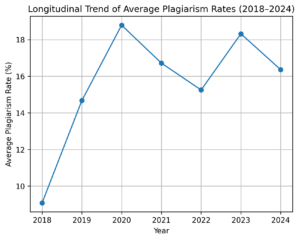
Figure 1: Average plagiarism rates across seven years, showing a notable increase during the COVID-19 pandemic period and subsequent fluctuations.
Impact of Global Disruptions
The period between 2019 and 2020 saw the most significant rise, coinciding with the abrupt shift to remote learning. As students faced limited supervision, disrupted routines, and heightened stress, many turned to shortcuts, resulting in elevated plagiarism rates. Data indicate that in 2020 alone, nearly one in five submissions contained non-original material, representing an increase of over 28% compared to the previous year. After 2020, plagiarism rates declined temporarily in 2021 and 2022, suggesting that institutions gradually adapted to new teaching formats and reinforced preventive measures. However, 2023 witnessed another increase, hinting at persistent challenges in sustaining academic honesty amid hybrid learning models.
Regional Variations and Institutional Context
Global longitudinal studies further reveal significant regional variations. In 2024, plagiarism rates ranged from approximately 5% in Germany to nearly 30% in Brazil, while the United States and Australia recorded rates around 27%. Countries in Asia, such as Japan and India, showed rates between 8.7% and 18.2%, reflecting differences in academic culture, institutional enforcement, and access to technology. Notably, Ukraine reported one of the lowest plagiarism rates globally at 6.3%, suggesting that local educational practices and policies may play a critical role in shaping long-term trends.
The Role of Technology and AI
The influence of technology on plagiarism over time is particularly complex. On one hand, AI-powered plagiarism detection systems and advanced text analysis tools have enhanced the ability to identify copied or paraphrased content, making longitudinal tracking more reliable. On the other hand, generative AI and text-synthesis software have introduced new avenues for producing content that appears original while bypassing traditional detection methods. Surveys indicate that these technologies have contributed to shifts in plagiarism behavior, as students experiment with AI-generated text to meet academic requirements without fully understanding the ethical implications.
Attitudinal Shifts and Long-Term Change
Longitudinal research also examines attitudinal changes alongside behavioral data. Studies conducted over a decade at individual universities indicate that education and awareness programs can gradually reduce instances of plagiarism. Students exposed to comprehensive academic integrity training demonstrated a growing understanding of ethical scholarship and a decline in self-reported plagiarism, even as the overall volume of digital content increased. These findings suggest that cultural change and policy enforcement are as crucial as technological tools in shaping long-term trends.
Conclusion: Insights from Longitudinal Analysis
The longitudinal perspective provides a framework for evaluating the effectiveness of interventions and for contextualizing spikes in plagiarism. Temporary increases, such as those observed during the pandemic, may reflect external pressures rather than systemic failure. By tracking trends over multiple years, researchers can differentiate between episodic disruptions and persistent structural issues, enabling more nuanced strategies for prevention. Institutions that invested in faculty training, student orientation programs, and robust detection systems observed sustained improvements, highlighting the importance of proactive measures rather than reactive enforcement.
Plagiarism is a dynamic phenomenon that evolves under the influence of technological, cultural, institutional, and global factors. Longitudinal analysis illuminates these patterns, revealing that while crises like the COVID-19 pandemic can trigger temporary spikes, sustained reductions in plagiarism depend on education, policy enforcement, and ethical culture. By examining data across multiple years, researchers and educators can better anticipate challenges, evaluate the impact of interventions, and design strategies that promote originality, integrity, and trust in academic and professional contexts. The integration of detection technologies, awareness initiatives, and supportive learning environments is essential for ensuring that plagiarism remains a manageable rather than pervasive concern over time.