

Universities face an increasingly complex challenge in maintaining academic integrity. The rise of artificial intelligence and the widespread availability of online content have transformed plagiarism from simple copy-paste behavior into a more nuanced and sophisticated phenomenon. Selecting the right plagiarism detection platform is no longer a matter of choosing a familiar tool; it has become a strategic decision that affects the credibility of academic programs, student outcomes, and institutional reputation.
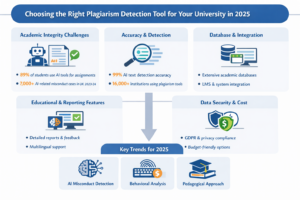
Historically, plagiarism detection relied on basic text-matching systems that compared student submissions with a database of prior work and publicly available web content. While these methods remain effective for detecting straightforward copying, they are less capable of identifying subtle paraphrasing, AI-generated content, and self-plagiarism. In fact, recent surveys indicate that up to eighty-nine percent of students admit to using AI tools to assist with writing tasks, which makes it increasingly difficult for traditional software to discern original work from assisted work. A study in the United Kingdom reported nearly 7,000 confirmed cases of AI-related academic misconduct in the 2023–24 academic year, highlighting the urgency for institutions to adopt more sophisticated detection systems.
Accuracy and Detection Capability
Universities in 2025 must prioritize accuracy in a plagiarism detection platform, as the ability to identify both traditional and AI-assisted forms of plagiarism is crucial. Tools such as Turnitin remain popular due to their extensive databases, which include billions of academic and web-based sources, and are licensed by over 16,000 institutions globally. Modern platforms, including Copyleaks, leverage machine learning to identify AI-generated content with reported accuracy rates exceeding ninety-nine percent for certain language models. Ensuring minimal false positives and false negatives is critical, as misidentifying student work can erode trust and hinder learning outcomes.
Database Coverage and Integration
Another essential aspect of choosing a platform is database coverage. A tool’s effectiveness is directly linked to the breadth and quality of its reference material. Comprehensive systems compare submissions against publicly accessible content, proprietary academic journals, thesis and dissertation archives, subscription-based digital libraries, and internal institutional repositories. A wide-ranging database increases the probability of detecting matching content and provides a more complete overview of academic work, allowing faculty to address potential misconduct with confidence.
Integration with existing university systems is equally important. Plagiarism detection software should work seamlessly with learning management systems such as Canvas, Blackboard, Moodle, or Brightspace, as well as student information systems and submission portals. Seamless integration streamlines academic workflows, reduces administrative burdens, and allows faculty to run similarity checks without leaving the platform, which is particularly important in large institutions with high submission volumes.
Reporting, Educational Value, and Multilingual Support
The reporting features of plagiarism detection tools are another key consideration. Clear, actionable, and easily interpretable reports are necessary for both instructors and students. Platforms that provide color-coded similarity highlights, detailed source breakdowns, and percentage similarity scores allow faculty to evaluate potential plagiarism efficiently. Additionally, tools that enable the exclusion of properly cited material or bibliographies help prevent misinterpretation and support fair assessment practices. An intuitive user interface ensures that faculty can adopt the platform without extensive training while allowing students to learn from feedback effectively.
In addition to detection, the educational value of a plagiarism detection tool has become increasingly significant. Systems that guide students in understanding why certain content is flagged and how to correct it provide a pedagogical benefit that enhances learning outcomes. By offering detailed feedback on citations, grammar, and proper paraphrasing techniques, these platforms can transform the detection process into an opportunity for students to improve their academic skills.
Multilingual support is another consideration for universities with diverse student bodies. The ability to detect plagiarism across multiple languages and scripts is essential in a globalized academic environment. Without this capability, institutions risk missing instances of misconduct in non-English submissions, undermining academic integrity.
Data Security, Cost, and Emerging Trends
Data privacy and security play a vital role in platform selection. Universities must ensure that the chosen tool complies with applicable data protection laws, such as GDPR in Europe, and that submitted content is stored securely without unauthorized access. Institutions must carefully evaluate whether the vendor retains copies of student work and whether this practice aligns with internal policies and ethical standards.
Financial considerations are also critical. The cost of plagiarism detection tools varies widely, with options ranging from per-submission fees to campus-wide licenses. Given the projected growth of the global anti-plagiarism software market in the coming years, universities must balance the need for advanced features with budget constraints, ensuring that the investment delivers long-term value.
Technological trends are shaping the evolution of plagiarism detection. AI-driven misconduct is a significant challenge, requiring tools that update continuously to detect new forms of AI-assisted writing. Emerging research explores behavioral and contextual detection methods, such as keystroke dynamics and writing pattern analysis, which can complement traditional text-matching techniques. Studies suggest that incorporating behavioral signals can improve detection accuracy, particularly for AI-generated content. Furthermore, universities increasingly use plagiarism tools as part of educational initiatives, emphasizing learning and awareness rather than solely punitive measures.
Conclusion
Selecting the right plagiarism detection tool for a university in 2025 requires careful consideration of multiple factors, including accuracy, database coverage, AI detection, system integration, reporting clarity, educational impact, multilingual support, data security, and cost. By evaluating these criteria and staying informed about emerging trends, universities can uphold academic integrity, adapt to evolving writing behaviors, and strengthen their educational mission in a rapidly changing technological landscape. Choosing a well-suited plagiarism detection platform is not merely a technical decision; it is an investment in the credibility and quality of higher education for years to come.